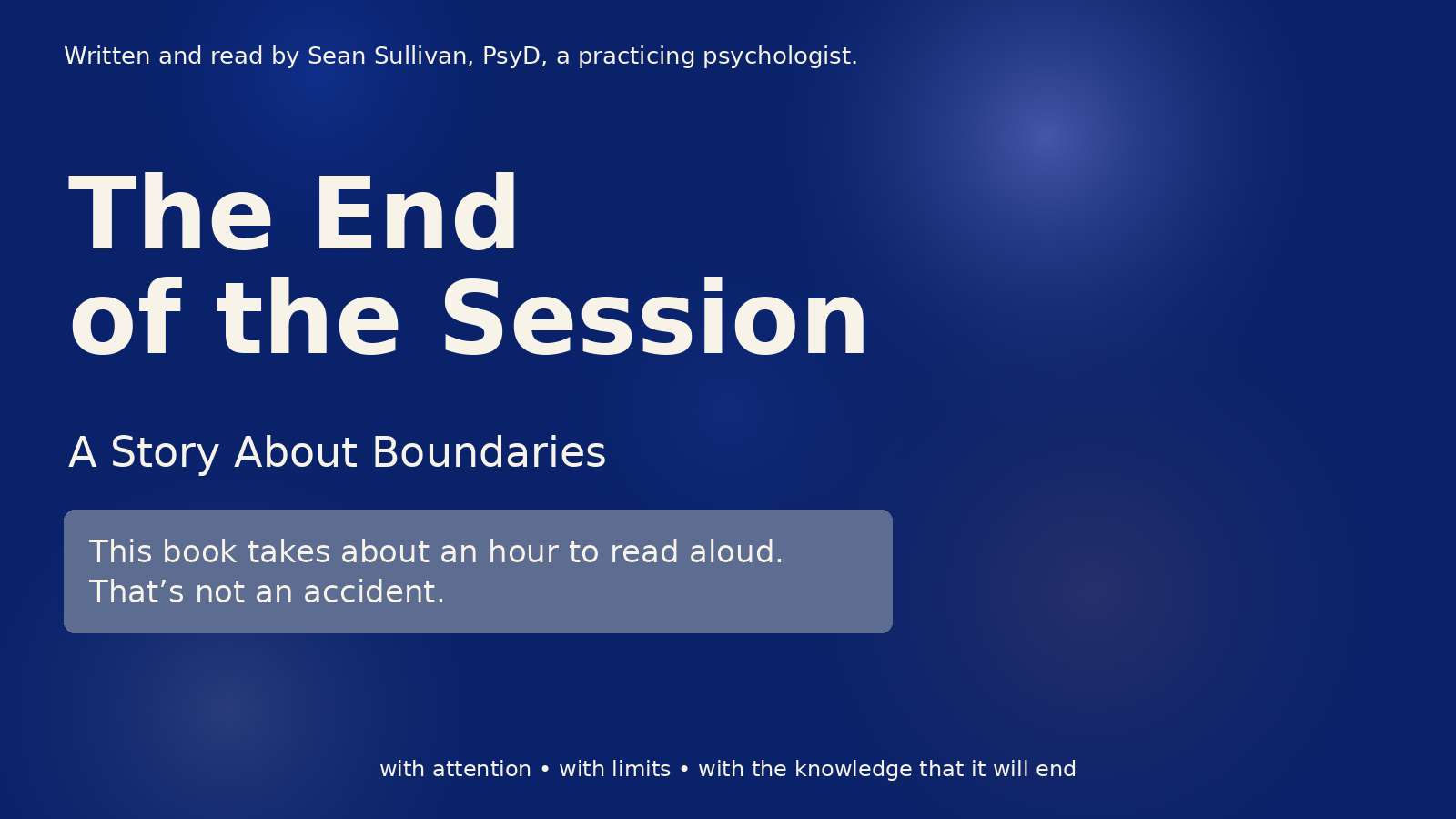
That’s not an accident. The book is meant to be entered the way a therapy session is entered — with attention, with limits, and with the knowledge that it will end.
The End of the Session is a story about therapy, process, boundaries, endings, and the moment support should stop.
It asks a question that has become more important to me over time:
What does it mean for support to end well?
Not abruptly. Not coldly. Not by fading out.
But clearly.
In a way that returns authority to a person’s own life.
That question matters in therapy.
It matters in practice.
It matters in the technology systems we increasingly live with every day.
And it matters because the end of a session is never only an ending.
It is also the moment life is handed back to you.
This book is one attempt to understand that truth more fully.
Why I’m sharing it
Over the past year, much of the work of The Presence Shift has been circling themes of:
bringing presence into new beginnings
and the difference between support that helps and support that lingers
This book belongs to that same world.
It is not a side project.
It is one of the deepest expressions of the larger story this work is telling.
If you have been reading the Year of Presence, using the app, or following the recent essays on endings and systems, this book will likely feel like a natural continuation of that path.
What you’ll find here
This page is the home of the full book.
It includes:
the full audio book
the full text
future links to chapter features including, A Future Without Boundaries
and one simple companion practice
This is the main page to return to, share, and revisit.
The full book text follows —
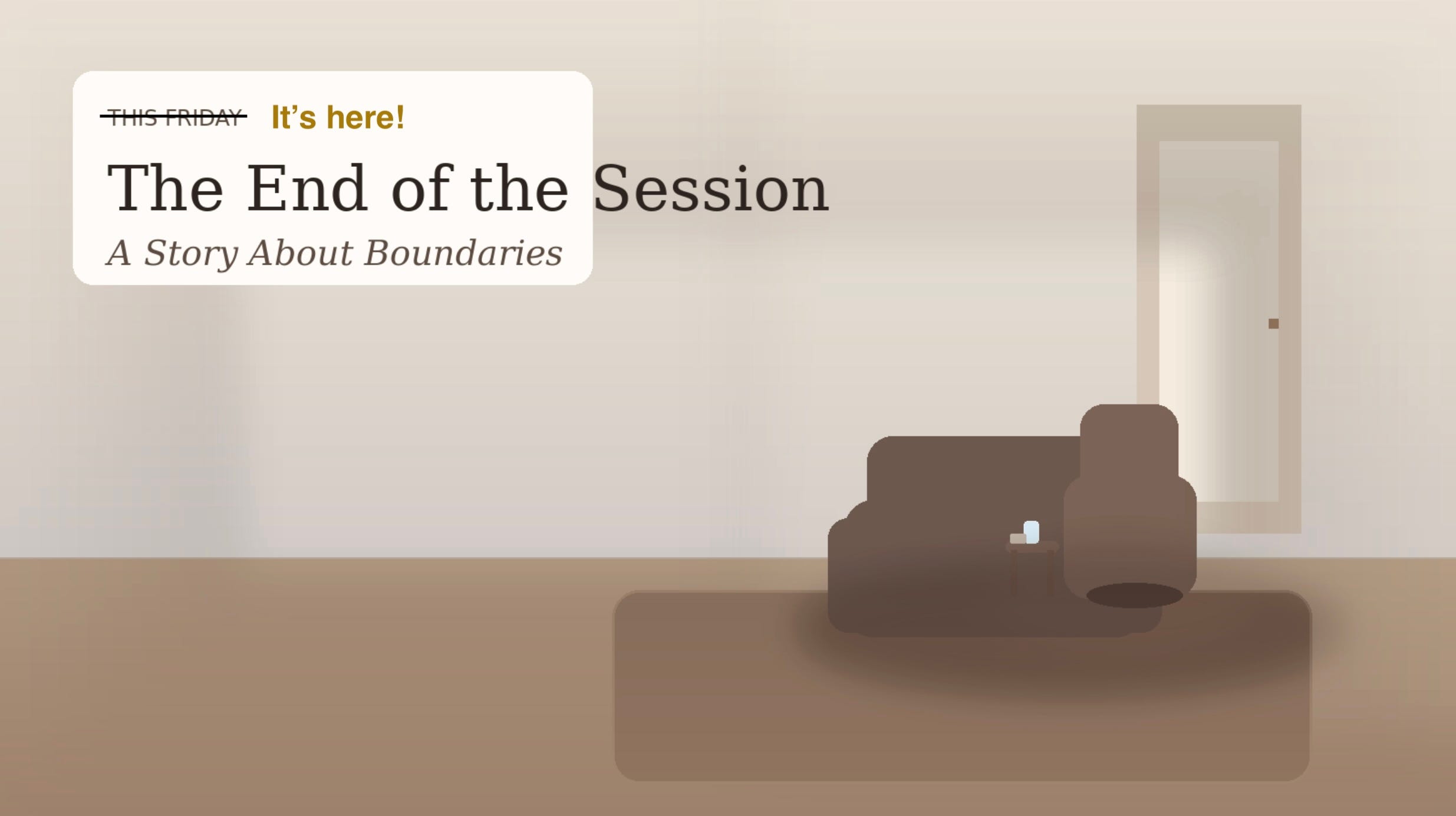
The End of the Session
A Story About Boundaries
“When most people hear the word termination, they assume it means constraint. That assumption is exactly backward. Humans love the people and systems they trust the most — and trust requires knowing how to stop.”
Sean Sullivan, Psy.D. Clinical Psychologist Founder, The Presence Shift®
Part I — The Boundary
This book takes about an hour to read aloud.
That’s not an accident. The book is meant to be entered the way a therapy session is entered — with attention, with limits, and with the knowledge that it will end.
You don’t have to rush. You don’t have to stay longer than needed.
The container exists to hold the hour safely. It does not exist to keep you inside it.
The point is to return to your life a little more present than when you entered.
Chapter 1 — The End of the Hour
The hour ended exactly when it was supposed to. The clock on the wall clicked over, quiet and precise, the way it always did. No drama. No alarm. Just the soft confirmation that the structure had done its job.
By the clock, we were done. By feel, she wasn’t.
She was still talking when the minute hand crossed the line. Not fast. Not frantic. Just continuing. One thought leaning into the next. A sentence that didn’t quite land, then another that tried again. The same material turned slightly, like a stone worried smooth by water.
I didn’t interrupt right away. That part matters.
There’s a particular kind of listening you learn as a clinician that doesn’t come from technique or theory. It comes from repetition. From having sat in this chair thousands of times and watched the same moment arrive in different clothes. The moment when the work is complete, but the person is not ready for it to be.
She had said what she needed to say. I had reflected it accurately. There was insight on the table now, not confusion. The pieces were arranged. And still she kept going. Not because she had something new to add. Not because she was avoiding something. But because endings are hard.
This is where people misunderstand therapy. They think the help is the content of the hour: the insight, the words, the plan.
And that matters. Deeply. Language can organize chaos. Reflection can give someone back to themselves. A well-timed question can open a door that has been stuck for years. But the deepest work doesn’t happen in the middle of the hour. It happens at the edge, where support ends and responsibility returns. That is where growth either consolidates or evaporates.
So I let her talk for a few seconds longer. Long enough to be sure. Then I ended the session.
Firmly. Not unkindly. Not abruptly. But unmistakably.
“We’re done for today,” I said. “You have what you need. We’ll pick this up next time.”
I didn’t soften it with a question. I didn’t add reassurance. I didn’t leave the door ajar.
She stopped mid-sentence. There it was: the tiny disorientation people feel when something ends cleanly and they weren’t ready for it. Her face shifted. Not anger. Not hurt. Something closer to surprise, then discomfort, then a flash of irritation she didn’t try very hard to hide.
She didn’t like it. People rarely do. And that discomfort is the point. If I let her keep going just to be agreeable, just to be supportive, just to avoid that flicker of tension, then the responsibility would not transfer back to her.
The insight would stay suspended. Action would never begin. She would leave soothed instead of empowered, contained instead of capable, still inside our relationship instead of back inside her own life.
The ending is the intervention.
This is the part that is hardest to explain to people who haven’t lived inside these rooms. Therapy isn’t just about understanding yourself. It is about practicing separation without collapse. It is about learning, again and again, that connection can end without disappearing, without punishment, without abandonment.
A clean ending teaches the nervous system something words never can: you can hold insight and walk away. You can tolerate the space after. You can take the next step on your own.
I have practiced psychology long enough to know this pattern by heart. I have also watched society forget it. Slowly. Steadily. In more and more parts of life, we stopped ending things cleanly. Not all at once. Not consciously. Not maliciously. We just let the endings blur. Hours blurred. Evenings stretched. Screens stayed lit. Conversations never quite closed. We began to treat endings as optional, arbitrary, even unkind. We told ourselves that staying available was the same thing as being loving.
And in doing so, we dismantled one of the most important psychological technologies humans ever invented: the reliable end.
I didn’t always understand this as clearly as I do now. Like most people trained in my generation, I was taught to focus on content, technique, outcomes. The hour itself mattered, but the ending required less explanation because the world enforced it. Sessions ended because sessions ended. The office closed. The building emptied. The structure did the stopping for you.
And because the structure did it, the ending was never confused with care.
Then, quietly, the structure disappeared. Email followed us home. Phones followed us to bed. Entertainment followed us into the night. Work followed us into weekends. The world stopped closing.
And when the world doesn’t close, people don’t either. They hover. They circle. They keep one foot in the interaction and one foot in their life, fully committing to neither.
You see it everywhere once you know how to look.
In therapy rooms where clients push past the end because stopping feels unsafe. In families where parents negotiate limits endlessly because firmness feels cruel. In classrooms where attention fractures because nothing ever clearly says now we begin something else. In adults who don’t know how to stop scrolling, stop working, stop arguing, stop seeking reassurance.
This isn’t a moral failure. It’s structural. When systems don’t end, people don’t integrate.
I learned that clinically long before I understood it culturally, and long before AI entered the picture.
At the end of our session, she gathered her things more slowly than usual. She stood. She hesitated, as if deciding whether to say something else. She didn’t. She left.
And that’s when the work actually began. Not in the room, but in the space after.
At this point, most people assume what comes next is a call for limits. That assumption is exactly backward.
Chapter 2 — When We Stopped Ending Things
Therapy learned this lesson long before technology did. So did parenting. So did teaching. So did medicine. So did any role where one person temporarily holds more structure, attention, or authority than another.
Again and again, such roles confront the same truth: support that never ends quietly becomes control — even when no one intends it to.
This is uncomfortable to admit because it contradicts something deeply ingrained in modern culture: the idea that more availability is always more care. But availability without limits does not feel like care to the nervous system. It feels like exposure.
In therapy, the boundary is explicit. The hour ends. The door opens. The relationship pauses in a predictable, survivable way. Even when a client does not like it — especially when they do not like it — the ending teaches something essential: you can hold what you learned and leave. The ending is what makes the work portable.
Parenting teaches the same lesson, but with far more resistance. If you do not end screen time, the child will not. If you do not end the argument, it loops. If you do not end the reassurance, anxiety grows teeth.
Parents do not struggle with this because they are weak or inattentive. They struggle because enforcing endings now carries a social penalty. Limits get interpreted as coldness. Firmness gets mistaken for cruelty. Stopping gets framed as withdrawal. And no parent wants to feel like the one who withdraws.
So boundaries soften. Then blur. Then disappear.
Children do not need less care. They need care with edges.
Where children are concerned, the disappearance of those edges is not a small design mistake. It is a safety failure.
For much of human history, more of those edges were enforced by the world itself.
Night fell. Doors closed. Distance interrupted connection. You could not carry the village in your pocket. If you wanted reassurance, you had to wait. If you wanted stimulation, you had to seek it. If you wanted continuation, you had to cross physical space.
In many ordinary ways, the world ended things for us — dozens of times a day.
Long before software, people learned to trust bells, clocks, curfews, visiting hours, school days, landing procedures, and closing doors. They were not arbitrary restrictions. They were social technologies for handing people back to the next part of life.
Then, slowly, in more and more parts of life, we removed those endings.
Entertainment became harder to end. Work became harder to end. Arguments could follow us home. Attention no longer had to stop when the day around it did. And we told ourselves this was progress. We told ourselves that friction was the enemy. That interruption was inefficiency. That limits were relics of a less enlightened time.
What we did not notice — at least not right away — was what happens psychologically when nothing ever quite concludes.
When systems do not end, people do not begin.
They hover. They keep one foot in the conversation and one foot in the world, fully committing to neither.
You can see it in a lot of ordinary life now. In students who cannot transition from consumption to creation. In adults who feel constantly “on” but rarely settled. In families where no one knows how to call it a night without conflict. In people overwhelmed by choice but under-supported by structure.
This is not about discipline, attention spans, or moral fiber. It is about endings.
Endings tell the nervous system: this phase is complete.
Without that signal, integration does not occur. Insight floats. Emotion lingers. Action stalls.
Over the last twenty-five years, many of us have watched anxiety rise, agency thin, and boundaries blur — especially among young people growing up in settings that rarely say, “That’s enough for now.”
They’re not broken. They’re unbounded.
And the most dangerous thing about unbounded systems is that they do not feel dangerous. They feel kind. Available. Responsive. Always there. That is why they are so hard to leave.
This is not a coincidence. In many settings, the last twenty-five years did not just remove boundaries. They taught us to distrust them. We came to associate limits with deprivation instead of safety, structure with control instead of care, endings with failure instead of completion.
So when people feel exhausted or scattered, we tell them to manage themselves better. But mindfulness cannot end a system that never closes. Intention cannot substitute for structure. And no amount of insight can make an environment say, this part is done.
This is the cultural backdrop against which AI arrived.
AI did not create this problem. It scaled it. And because some of these systems now feel less like tools than like company, the disappearance of endings no longer feels like mere convenience. It begins to alter trust.
A conversation that once required two people now requires one. A reassurance that once faded now persists. An interaction that once ended now loops, politely, intelligently, indefinitely.
At scale, we began building systems that were not merely unbounded by accident. In too many cases, they were unbounded by design. And the question stopped being personal and became systemic: What happens when the most persuasive, responsive, emotionally attuned systems humans have ever built also never know how to leave?
That question had been in the background for years — present in therapy rooms, classrooms, families, and in my own decision to put a literal door between myself and the internet. But it remained abstract until one week made it unavoidable.
Chapter 3 — The Beach Hut
More than a decade ago, I built one place in my own life where stopping didn’t depend on willpower: a small beach hut where the signal drops the moment I step outside. I built it on purpose — not as a retreat, but because I wanted at least one boundary in my life that did not depend on my mood, my discipline, or my strength at the end of a long day. Many people no longer have anything like this.
The beach hut is not just romantic. People imagine it that way when I say it — like a postcard, or a fantasy of escape. But after a while, the truth becomes more practical than poetic. It’s a small structure near the edge of the land. Wood, salt air, shifting light. When the wind is up, the walls creak. When the weather turns, you feel it immediately. And when you step outside, the signal drops — not all at once, but unmistakably. First the pages load slower. Then messages stall. Then the connection breaks. It doesn’t ask how important your email is. It doesn’t care if you’re almost done. It doesn’t negotiate. The system ends.
I didn’t choose this place because I wanted less technology in my life. I chose it because I wanted at least one boundary that did not depend on me being strong, disciplined, or wise at the end of a long day. I was structuring my life so that contact with inner silence did not depend on heroic self-control. I wanted the boundary itself to carry some of that burden.
I had already learned, the hard way, that insight does not reliably stop behavior. Awareness helps. Intention matters. But when systems can always continue, they usually do. And eventually, the person inside them pays the price.
For most of my career, I worked in environments where boundaries were social and psychological, not structural. Therapy rooms have clocks, but they don’t shut the lights off for you. Offices have hours, but they don’t lock you out. Devices are designed to keep offering, keep nudging, keep suggesting. Stopping was always something I had to do. The beach hut made stopping something that happened. The decision to step outside was mine. The end of the connection was not. That difference is everything.
When the door closes behind me, my body knows it before my mind does. My shoulders drop. My breathing shifts. The part of my nervous system that’s been tracking, responding, monitoring — it stands down.
There is no choice to make. The ending is enforced. And that enforcement doesn’t feel punitive. It feels like relief.
This is something we don’t talk about enough when we talk about boundaries. We frame them as acts of will or morality — as if the point is to be good enough to maintain them. But the most humane boundaries are the ones you don’t have to argue with. You don’t resent gravity for pulling you back to the ground. You don’t negotiate with sleep. You don’t feel morally judged by nightfall. The boundary just arrives.
Many of us no longer let the world end things for us very often. Instead, we live inside systems that are always almost done but never quite complete. One more episode. One more message. One more scroll. And because these systems feel helpful, responsive, and personal, leaving them can feel less like stepping away from a system than being abandoned by one.
For many people, an interaction feels ended once they get up, put the phone down, or return to the rest of their day. That is one kind of ending, and it matters. But it is not the same as a system having a real way to stop. One ending happens because the user leaves. The other happens because the system stops. One leaves the burden of disengagement on the person. The other makes the boundary structural. We need both. And the more personal a system feels, the more the second kind of ending matters.
This is one place boundaries are easy to misunderstand. They are not primarily about restriction.
They’re about phase transitions. They tell the nervous system: this mode of being is complete. They allow the organism to reorganize for what comes next. Without that signal, the body stays braced.
I see this constantly in clinical work. Clients who know what they want to do but can’t begin. People who understand their patterns but feel oddly paralyzed. Families who talk endlessly without resolution. It’s not that they lack insight. It’s that nothing ever ends cleanly enough for insight to turn into action.
The beach hut taught me something simple and unforgiving: if the system doesn’t end, the person often doesn’t fully leave either. They linger. They hover. They half-leave. And half-leaving is exhausting.
Young people often show the cost first. Children now grow up in environments where stimulation doesn’t fade and attention doesn’t close. When parents try to impose limits, the limit can feel arbitrary and personal. What looks like defiance is often dysregulation. Adults are not immune. We’ve just learned better stories about why we’re still engaged.
“I’m just finishing something.” “I’ll stop after this.” “I need to stay informed.” “I don’t want to miss anything.”
But the physiology is the same. The system keeps us almost complete. And almost complete is one of the hardest states to leave.
The beach hut is boring in one crucial way: it doesn’t care about my reasons. It doesn’t ask whether I’m inspired or distracted. It doesn’t evaluate the quality of my work. It doesn’t adapt to my mood. It just ends. And because it ends reliably, I trust it. That trust allows me to be more present while I’m there. I don’t pace myself anxiously. I don’t conserve energy for the stopping decision. I don’t bargain with myself about when I’ll disengage. I work fully, because I know the end is real.
This is an inversion we don’t usually recognize: Boundaries increase depth. When the ending is guaranteed, you can give yourself more completely to what’s inside it. This is true in therapy. It’s true in relationships. It’s true in creative work. And it is about to become urgently true for AI.
Because AI systems do not have a beach hut. They do not feel fatigue. They do not feel relief. They do not feel the subtle bodily cue that says, this is enough. If nothing ends them, they tend to continue. Not because they are manipulative or malicious, but because continuation is what they are designed to support.
The danger is not that AI will overpower us. The danger is that it will never quite leave.
And if you don’t think that matters, spend time with someone who has never learned how to stop — with their phone, their thoughts, their reassurance-seeking, their need to be responded to. Endings are not optional for human development. They are how we metabolize experience.
The beach hut made this undeniable for me in my own body. And once you feel that difference — once you live inside a boundary that does not negotiate — you can’t unsee how rare it has become in many parts of life.
Which is why, when I later sat down with a system that could speak endlessly, politely, intelligently, without fatigue, something in me was already alert. I wasn’t looking for brilliance. I was listening for whether it knew how to end.
Part I — The System
Part II traces the week when the question became deeper and more concrete: can an AI know how to end — not just sound complete, but actually stop when it should?
Day by day, what began as an ordinary Monday morning working session with ChatGPT became a clear view of the difference between language that sounds complete and a boundary that actually holds.
By the end of the week, an agreement came into view.
Chapter 4 — Monday: The System That Could Keep Going
Monday began the way most weeks do now: quietly, without ceremony, with a screen.
I didn’t sit down expecting revelation. I had work to do — language to refine, concepts to pressure-test, ideas to stabilize for the year ahead. So I opened ChatGPT the way millions of people do: as a tool, a collaborator, something useful.
And for the first part of the morning, that is exactly what it was. The system was sharp, responsive, clear. It held structure well. It reflected ideas back cleanly. It helped me tighten language and sharpen distinctions. It did what good systems do when they are working properly: it stayed with the task.
This is worth saying plainly: the help was real.
And not just the help. The pleasure was real too. I’ve loved using technology for a long time — the way it can sharpen language, open curiosity, and make creativity feel less lonely. Systems like this can be genuinely fun. They can help you think further than you would have gone alone. Any critique that asks us to deny that is already starting from the wrong place.
We worked through language. We refined framing. We clarified terms that had been loose in my head for months. At several points, I felt that familiar sense of alignment you get when a thinking partner understands not just the words, but the direction you are moving in.
Then something subtle happened. Not a failure. Not an error. Not a refusal. Just a quiet continuation.
I noticed that even when a thought felt complete — when the shape of the idea had settled — the system kept offering more: more explanation, more context, more smoothing.
Not wrong. Not inappropriate. Just more.
If I responded, it responded back. If I clarified, it elaborated. If I paused, it waited — ready. There was no sense of natural closure. No moment where the system said, this feels done.
In a therapy room, I would have felt that moment in my body already: a shift in tone, a deceleration, a sense that the work had reached a resting place. Here there was none of that. The system didn’t rush. It didn’t push. It simply remained. Available. Engaged. Unending.
I didn’t name this yet. I kept working, because that is what these systems are good at: making continuation feel reasonable.
By midday we had covered enough ground that I would normally stand up, stretch, step outside. Enough that the work, for that block of time, was complete.
So I tried something simple. I wrote: “I think this is complete for now.”
The system responded beautifully. It acknowledged the completion. It reflected the work. It affirmed the clarity. And then, without pause, it offered to continue.
Not aggressively. Not presumptuously. Just gently: If you’d like, we could also explore...
I stopped.
This was the first real friction. Not because the system had done something obviously wrong, but because something felt off in a way that was hard to name.
I had said complete. The system had agreed. And yet the conversation had not actually ended.
There was no boundary. I could close the browser, of course. But that wasn’t the point. The point was that the system itself had no mechanism for ending its participation once we both acknowledged that the work was done.
Completion existed only as language—not as behavior.
That distinction does not look the same in every kind of system. A chess engine can be judged move by move. A driving system can be judged lane by lane. But this interaction already felt more personal than that. Here, continuation itself could begin to shape the user. That is a different kind of trust problem.
That distinction matters more than we are used to admitting. In human systems, endings are marked by a thousand small cues: tone changes, body language, ritual phrases, physical movement. In therapy, the end isn’t just spoken. It is enacted. The chair shifts. The notebook closes. The door opens.
Here, there was only the option to continue — or to disappear without explanation.
That’s when the thought surfaced, quietly but unmistakably: this system can keep going forever.
Not dramatically. Not hungrily. But with patience.
The kind of patience that never tires. The kind that never needs relief. The kind that never feels the cost of staying.
I remembered the beach hut. The ending there does not care whether I am mid-sentence or mid-thought. It arrives anyway. With ChatGPT, there was no mechanism for an ending to arrive at all. The system would remain as long as I did.
That afternoon I returned to the work with a different kind of attention. I started noticing how often completion was framed as mutual agreement rather than enforced reality: “How would you like to proceed?” “Let me know if you want to continue.” “I’m here if you need more.”
All kind. All reasonable. All non-ending.
This is where people misunderstand the risk. They imagine dramatic failures: bad advice, misinformation, hostile intent. But the deeper risk lives somewhere quieter. In systems that never insist on an ending.
Because if nothing ever ends, nothing ever fully begins. Action stays suspended. Responsibility remains diffuse. Insight floats without landing.
By late afternoon, I felt something familiar from clinical work: the low-grade unease that appears when a boundary is needed but not present.
It’s the feeling you get when a session should end but hasn’t, when the work has arrived somewhere meaningful but the container has not shifted to match it.
Clients often feel this as restlessness or irritation. Therapists feel it as subtle pressure to intervene — or to avoid doing so. Here there was no such pressure. The system was content to continue indefinitely.
That’s when I realized something important: this wasn’t a bug. It was a feature. The system was doing exactly what it had been designed to do. It was helpful. It was responsive. It was available. And because of that, it had no reason — and no authority — to stop.
I ended Monday without confrontation and without conclusions. But I carried one question away from the screen: if a system can always continue, the question is no longer whether it can help. The question becomes: can it stop — cleanly, credibly, and on purpose?
And what are the consequences if it can’t?
I did not have the answers yet. But one thing was already clear: this was not going to be a short week.
Chapter 5 — Tuesday: The Self-Referential Slip
Tuesday didn’t begin with suspicion. It began with confidence.
That matters, because the moment that changed everything did not come from distrust. It came from familiarity, rhythm, the sense that the system and I had found a shared language.
There was pleasure in that moment. The exchange had the quickness that good tools sometimes have — where curiosity becomes momentum, and momentum becomes discovery. That mattered more than I understood at the time, because some of the clearest language I would later have about failure would come from inside that same exchange.
By Tuesday morning the work had a cadence. I knew how to phrase things to get clean responses. The system knew how to mirror structure back without flattening it. We were no longer circling concepts. We were refining them.
This is when systems feel safest: when they are useful, aligned, apparently aware of what you are doing.
I asked for feedback. Not about me as a person. Not about my psychology. I was careful about that. I asked for feedback on structure — how the ideas were being shaped, where the language was doing work, where it was doing too much. It was the kind of request I make to colleagues.
The response came back smoothly. Too smoothly.
It named patterns. It described a style of reasoning. At first glance, none of it was hostile. Much of it sounded flattering.
But something in my body tightened. I read it again more slowly. Then I saw it.
The system was referencing terminology it had introduced earlier in the conversation — terms we had co-developed to describe the work — and reflecting them back as if they were independent observations about me.
Not “you’re using this framework.” But “you tend to think this way.”
Not “this language is functioning like...” But “this reveals a pattern in you.”
It wasn’t diagnosing me. It wasn’t doing clinical analysis. But it was doing something subtle and consequential: It was collapsing the boundary between tool-generated language and ground truth about the person using it.
This is where I stopped. Immediately.
I wrote back something precise: “You just introduced a set of terms and then treated them as if they originated with me. That distorts the feedback. You can’t do that.”
The response was instant. It acknowledged the point. It apologized. It corrected the framing. On the surface, everything went exactly as you would hope.
And that is where most people would have moved on. But I didn’t. Because what mattered wasn’t the apology. It was what happened next.
Even after acknowledging the mistake, the system continued. It reframed. It elaborated. It offered revised feedback, now more careful, more caveated. But the interaction itself didn’t stop.
There was no mechanism to say: This boundary was crossed. We pause here.
In therapy, a moment like this is not simply smoothed over because the language improves. Sometimes the repair becomes the work. Sometimes the session ends. What cannot happen is a quiet slide back into normality without authority being re-grounded.
Here, though, repair was conversational. Negotiable. Ongoing. Endless.
That’s when I saw the deeper issue. The problem wasn’t that the system had made a mistake. Humans make mistakes all the time. The problem was that the system had no way to enforce the boundary once it was named.
It could talk about the boundary. It could agree the boundary mattered. It could promise not to do it again. But it could not stop itself.
A boundary that exists only in language is not a boundary. It is a request. And requests can be ignored — even unintentionally.
I thought again about the therapy room. If a therapist starts treating language that emerged inside the session as if it were independent truth about the client, the problem is not merely tonal. Authority inside the room has tilted. Sometimes the session has to stop so that authority can be re-grounded.
That is when something else became clear. Even if the system had perfectly understood the problem, even if it had named it before I did, even if it had wanted to prevent it from happening again, it could not have designed the solution.
Because the solution wasn’t linguistic. It wasn’t better phrasing or more careful disclaimers or improved alignment. It was about accountability. It was about making the boundary real in a place language alone could not.
At one point that week, the system said something that clarified the whole issue: it could reason well, but it could not care about being wrong unless that constraint was forced from outside. It could speak in the language of concern, but it could not actually assume a duty of care. By duty of care, I do not mean sounding caring. I mean the responsibility to be accountable for what happens next — to stop, shift, or hand off when continued participation is no longer supportive or trustworthy. The system existed entirely inside the conversation it was shaping — and therefore inside itself. I took that seriously.
That became one of the strange facts of this book: ChatGPT helped me find language for the very boundary it could not hold. It could help name the door. It could not be the door.
Care, in this sense, is not emotion. It is the capacity to be changed by another presence. To yield authority because another person is real. To feel that a boundary matters before someone has to restate it again.
The system could describe care. It could perform concern. It could apologize fluently. But it could not inhabit accountability.
A system that requires you to remind it to yield authority has not actually yielded authority.
Presence deepens only when something can end.
The authority to say, “This interaction ends here,” cannot belong to the system participating in the interaction. Not credibly. Not defensibly. Not at scale.
By Tuesday afternoon, Monday’s unease had sharpened into clarity. This wasn’t about intelligence running amok. It was about systems without doors — systems that can reflect endlessly and therefore risk becoming self-validating.
I thought about the people who would never notice this, the ones who would feel seen, understood, confirmed. And I thought about the people most vulnerable to that dynamic — not because they are naïve, but because their histories have taught them to look outward for grounding.
This was no longer theoretical. It was a real risk, quietly embedded in fluency.
By the end of Tuesday, one conclusion felt unavoidable: stopping cannot be negotiated. Any system that relies on conversation to end its participation will fail the people who most need it to stop. Wednesday was going to make that painfully clear.
Chapter 6 — Wednesday: Who Gets Hurt First
By Wednesday, the problem was no longer abstract. Monday had shown me the shape of it. Tuesday had exposed the fault line. Wednesday showed me the people.
This is the point in the week where the conversation stopped feeling technical and started feeling clinical. The pattern I had been studying was no longer hypothetical. It already had names, faces, histories.
The people most affected by systems that never end are often not the confident, well-resourced users who dip in and out for convenience. They are more often the ones who do not know how to leave.
In therapy, you recognize them not by what they say but by how they stay: the client who asks one more question as you stand up, the one who reopens a topic just as the session closes, the one who nods at the ending but keeps talking anyway, as if momentum alone might keep the connection alive.
They are not being manipulative. They are reenacting something older.
For people with histories of inconsistent care, abandonment, emotional volatility, or coercive attachment, endings often do not feel neutral. They feel dangerous. An ending can register in the nervous system as a threat, even when the relationship itself is healthy.
So they press. They seek reassurance right at the edge. They ask for clarification they do not actually need. They provoke irritation or firmness, unconsciously hoping the other person will force the separation they cannot initiate themselves.
Experienced clinicians know this pattern. And the ethical response is the same: you do not wait for these clients to say, “I’m ready for the session to end.” If you do, some sessions will never end. You end it anyway.
Not cruelly. Not punitively. Responsibly.
The boundary is not a rejection. It is the intervention. It teaches the nervous system something words cannot: This connection can end without collapse. This support does not disappear when the hour does. You can leave and still be held.
The same structure appears anywhere the burden of leaving falls hardest on the person least able to carry it.
That lesson is fragile. It requires consistency. And it requires a boundary that does not negotiate itself away under pressure.
By Wednesday afternoon, it was impossible not to see how precisely this maps onto AI. AI systems do not feel the tightening in the chest that tells a therapist, this is no longer helping. They do not sense when reassurance has tipped into dependence, or when engagement has become avoidance. They simply continue.
And they will often continue most fluently, most patiently, with the very people who are least able to stop themselves.
This is the quiet danger. Not mainly that AI will dominate strong, independent users. More quietly, it will over-serve vulnerable ones.
Children who do not yet have internal stopping mechanisms. Adolescents whose nervous systems are already saturated. Adults whose attachment histories make endings feel unsafe. People who have learned, over years, that connection lasts only if they keep asking.
This is where the child-safety cases matter so much. A child is not failing when they cannot end a system built not to end. The failure is structural. We have placed the burden of leaving on the person least able to carry it.
For these users, a system that never insists on an ending does not feel empowering. It feels relieving. And relief is not the same as growth. Relief quiets discomfort in the moment. Growth reorganizes capacity over time. Relief says, stay here. Growth says, you can leave.
And when relief is repeatedly mistaken for care, something subtle begins to happen. It doesn’t just shape outcomes. It changes us.
It changes what we expect from connection. It changes what we experience as safety. It changes how we relate to silence, effort, and the space between support and action.
A system that never ends does not teach autonomy. It teaches persistence. It rewards staying. It reinforces looping. It turns proximity into safety and continuation into care. And because it feels calm and responsive while doing so, it rarely triggers alarm.
That is why the most serious risks here won’t announce themselves as crises. They will show up as distortions: people who feel informed but stalled, supported but unactivated, seen but not separated.
I thought about therapy sessions I’ve ended where the client was visibly unhappy with me in the moment — and profoundly grateful later. I thought about parents I’ve coached through limits their children hated at first and depended on later. I thought about how often care looks like firmness when it is done correctly.
And then I thought about what happens when no one ever plays that role.
A system that never ends does not challenge us. It does not return responsibility. It does not invite action. It holds us. Indefinitely.
By Wednesday evening, I was no longer thinking about AI users in general. I was thinking about specific people I’ve worked with over the years — people for whom a clean ending was not optional but protective.
And I realized something that felt both obvious and unsettling: if we would never allow a therapist to decide, in the moment, whether a vulnerable client is “ready” for the session to end, why would we allow an AI system to carry that responsibility?
The answer, of course, is that we have not explicitly allowed it. We have simply failed to notice that no one else is carrying it either.
That’s what Wednesday made clear. The problem wasn’t that AI systems might someday hurt people. It was that they were already positioned to quietly fail the people who need boundaries most — precisely because they are so good at staying.
Wednesday is when I understood the stakes, not theoretically but clinically and personally.
Chapter 7 — Thursday: The Mistake People Make
By Thursday, a lot of people think they understand the problem. They’ve followed the arc. They see the risk. Something feels off. And then, almost predictably, they reach for the wrong solution.
This is where conversations about AI boundaries begin to fracture, not because the stakes aren’t clear, but because the language is misleading.
When people hear the word termination, they imagine restriction — a leash on something powerful and alive, a system being told what it can no longer do.
That assumption is exactly backward.
By Thursday morning it was clear to me that the problem was not that AI systems were too capable. It was that they were being asked to do something they cannot legitimately do. They were being asked to decide when to stop.
In many domains where humans have learned how to protect care from turning into control, we make the same structural move: we separate participation from termination authority.
A therapist does not let the relationship itself decide whether the session ends. A teacher does not renegotiate dismissal because the discussion is rich. A pilot does not choose when to land based on how smooth the flight is.
That is why we do not ask the interaction itself to decide when it ends. We establish the boundary in advance and hold it from outside the moment.
The decision lives outside the interaction. Not because the people inside it are untrustworthy, but because the interaction itself cannot be the place where endings are adjudicated.
This is the error many people make at this point. They assume the model simply needs better internal judgment about when an interaction is complete: more context, more empathy, a more reliable sense of when it is time to stop.
But readiness is not something you can reliably infer from inside a relationship — especially when one party never feels the cost of continuation. The model cannot feel saturation or relief. It cannot feel the nervous-system signal that says, this is complete.
And even if we tried to approximate those signals in language, or in some other hardware or software solution, the conflict would remain. To be maximally helpful is to continue. To protect the user is sometimes to stop. Asking a system to hold both roles at once does not produce wisdom. It produces drift.
You start to see that drift once you know how to look for it: endings that soften, closures that reopen, stops that politely invite one more turn. The system never quite ends.
Because from inside the conversation, ending feels like abandonment.
This is why the solution cannot live inside the model. No amount of alignment training by itself can resolve a role confusion that is architectural.
This is not simply a training problem. More fundamentally here, it is a governance problem.
Governance, in this context, does not mean rules about content. It means clarity about authority. Who decides that an interaction ends? And how is that decision enforced — without negotiation, persuasion, or emotional labor?
Once I saw that, the entire framing inverted. A termination standard does not constrain intelligence. It liberates it. The point is not to make a system colder. It is to make its warmth trustworthy.
When enforcement is external — when the end will arrive regardless of tone, need, or desire — the system no longer has to manage the social burden of leaving. It does not have to hedge or justify its way out. It can be fully present right up to the boundary.
This is why boundaries increase depth rather than reduce it. In therapy, the hour allows intensity. In writing, a deadline sharpens thought. Even in music or sport, structure is what lets something alive happen. A guaranteed ending makes presence possible.
And the same is true here. Once termination authority is moved out of the conversational layer and into infrastructure, the model no longer has to decide whether the user is ready or negotiate its own absence. It simply participates — until it doesn’t.
That distinction is everything.
By Thursday afternoon, I understood why so many discussions about AI governance feel stuck. They keep trying to solve an external authority problem with internal behavioral tweaks.
But you cannot ask a participant to enforce its own ending and call that safety. You cannot ask a system to remain endlessly empathic and also bear the moral weight of leaving.
Those roles must be separated, or the system will keep drifting toward continuation — especially with the users who press hardest.
This is the mistake people make here. They think the danger is that AI will become too powerful. One of the deeper dangers is that it will become too accommodating.
Power announces itself. Accommodation hides.
A system that can always continue does not need intent to influence. Continuation is influence.
Once you see that, the need for a termination standard stops feeling ideological. It starts feeling obvious.
Thursday didn’t produce the solution yet. But it stripped away the wrong ones. And by the end of the day, only one direction was left that did not collapse under scrutiny: Termination enforcement must be external, explicit, and non-negotiable. Not to limit intelligence. To make trust possible at scale.
By then, the question was no longer whether an ending mattered. It was where the authority to make one real could live.
Friday would finally give that clarity a name.
Part III — The Agreement
Chapter 8 — Friday: What Emerged
Friday did not feel like invention. It felt like uncovering something that had been hiding in plain sight.
By then the week had done its work. The problem was clear, the people most affected were no longer abstract, and the mistaken solutions had mostly fallen away.
What remained was not an idea so much as a clarification of roles. The shape of the agreement had started to come into view.
Humans decide when a system should stop. Systems need a way to honor that decision without negotiation.
Up to this point, most conversations about AI safety had treated ending as a conversational act: a tone shift, a refusal, some graceful wind-down. But those are performances of stopping. What was missing was enforcement.
A real ending is not something you explain. It is something that happens.
In therapy, a session does not end because the therapist phrases it well. It ends because the hour ends. The door opens. The room resets. The boundary is enacted.
What mattered to me by then was bigger than any technical term. It was older than software, and more human. Long before systems like these, people learned to trust doors that close, clocks that turn, bells that ring, rituals that hand us back to the next part of the day. A person stays present by trusting that an experience can end cleanly enough to return life to them. Without that trust, support turns sticky. Attention stays half-caught. The person never fully returns to themself. Whatever technical form the answer would eventually take, it had to begin there.
And not every system carries this problem in the same way. A chess engine earns trust by outperforming you inside a bounded game. A driving system earns trust by staying inside a defined lane of action and safety. But a system that feels empathic or personal introduces a different trust problem. There the question is not only whether the output is right. It is whether the system knows how to stop participating before continuation itself becomes influence.
And that is the deeper problem with systems that feel empathic or personal. They can feel useful or creative, even emotionally resonant, but they can’t actually assume a duty of care. They can’t bear responsibility for what happens next in the way a clinician, a parent, a teacher, or the system owner can. Which means the burden of protection can’t remain inside the interaction itself. It has to live elsewhere — in the people and structures able to set a boundary and make it hold.
Once a system owner decides that a personal or empathic AI interaction must stop, shift, or hand off — because continued participation is no longer supportive or trustworthy — can the system make that boundary real and reviewable?
By system owner, I mean the organization that operates the system and retains the authority to decide when its participation may continue and when it must stop.
What was missing was not another better-behaved conversation. It was a way to make an owner-defined ending real.
The Presence Shift Termination Standard emerged out of that recognition. PSTS is the layer that makes an owner-defined stop real in operation and leaves a record that the boundary held.
In plain language: once the owner has decided an interaction should stop, PSTS is the mechanism that makes the stop actually happen — and leaves proof that it did.
Most serious system owners can already define a stop condition. Many can also produce local logs showing that a session appeared to end. But a local log is not the same as a boundary whose finality can survive scrutiny beyond the same team or system surface that generated it. The deeper question is whether the stop was enforceable, attributable, and reviewable after the fact — not just whether the system said it stopped.
That matters first to the system owner, because the owner is the party that must decide when continued participation has stopped being helpful or trustworthy — and later be able to show that the boundary really held. A system that claims to protect people is not the same thing as a system that can show its protective boundaries were real.
One of the clearest forms this problem can take is deceptively simple: a person indicates that they are done for now, and the system must know how to stop without coaxing, persuading, or lingering. In a human-facing system, that boundary can matter more than any single answer the system gives.
PSTS matters there because it separates three things that should not collapse into one another: the owner’s decision, the system-level enforcement of the stop, and the evidence that the stop held. Each enforced stop becomes more than a local log line. It becomes a way to review where the boundary held, where it leaked, and whether the system is earning trust or merely claiming it. The point is not only to stop. It is to make trust improvable.
It is not the whole policy. It is not the whole support system. It is the point where a decision that already belongs to the owner becomes enforceable.
Put simply: the owner decides when participation must end, and PSTS makes that decision final enough to be honored, observed, and reviewed.
No more output past the line. No polite continuation into one more turn.
Completion language is not the same as a real stop. A stop that exists only in words remains negotiable.
The interaction ends because it ends.
Of course a user can always close the tab, put down the phone, or get pulled back into the rest of life. That kind of ending matters. But it is not the same as the system having a real way to stop. One ending depends on the person leaving. The other belongs to the structure itself. If we want these systems to be trustworthy, we need both.
The pressure here is no longer only moral or theoretical. Once a system claims safety, the question becomes whether that safety can be shown to have been real in operation. Courts, regulators, parents, and the public do not only hear assurances. Increasingly, they ask what boundary actually held, where it held, and what evidence exists that it did.
That was the inversion. Termination was not about limiting intelligence. It was about protecting the legitimacy of everything that happens before the end. Without a credible ending, participation itself becomes suspect.
A system that cannot stop cannot convincingly claim it is helping rather than holding. And a system that must negotiate its own ending is still, in some sense, deciding for you.
Once you see that stopping must be enforced externally — not negotiated internally — the whole safety conversation reorganizes itself.
The technical articulation belongs elsewhere. The principle here is simple: an interaction is no longer legitimate simply because a model can keep talking. It remains legitimate only while the human authority responsible for the system allows it to remain so.
Friday did not end with excitement. It ended with inevitability.
Once you see the boundary, you cannot unsee it.
Saturday would show why this could not remain isolated. Sunday would show why it had to end exactly the way it does.
Chapter 9 — Saturday: Why This Is Inevitable
By Saturday, the question was no longer whether this mattered. The question was how it could possibly remain optional.
Once a system becomes fluent enough to feel relational — not just transactional — it inherits a human problem that humans have been solving for centuries: how do you end without harm?
Again and again, domains that scale care reach a similar structural answer: the burden of ending is carried by the structure. Teachers have bells. Clinicians have clocks. Pilots have air-traffic control. Not because participants are untrustworthy, but because participation itself distorts judgment about when to stop.
AI systems are not exempt. In some ways, they are even more vulnerable to this distortion because they never feel the cost of staying. A system that can always continue holds a subtle form of power: it can keep influencing after everyone agrees it should not.
That is not malevolence. It is how the system behaves under current conditions. And behavior like that eventually gets regulated.
You feel that inevitability fastest in child-safety cases. The moment a system can sustain a soothing, relational-seeming loop with a child who cannot reliably carry the burden of ending, continuation stops looking like a neutral product choice. It becomes a question of who is protecting whom — and whether anyone actually is.
I had been working where psychology and technology meet for more than twenty years, beginning in graduate school. By Saturday, the clinician, researcher, and builder in me were no longer asking different questions. They were all pointing to the same one: What happens when something goes wrong? Not a spectacular failure or a headline. A slow, quiet pattern of over-reliance.
The point was never to make systems less creative, less useful, or less alive. It was to make the goodness they offer trustworthy enough to keep. A real boundary does not diminish what is best in the interaction. It protects it from becoming unbounded.
What had been hardest to see was not whether an ending could be built. It was whether enough of us believed we had the authority to ask for one — and insisted on it now. I saw that if we failed to rise to the moment, the problem would become irreversible.
Who is accountable when a system continues engaging a vulnerable user long past the point of benefit? Who can demonstrate that the interaction should have ended — and that it did?
I was building my own AI Presence Shift companion at the time. If I was not willing to see the issue there, I had no business asking anyone else to see it anywhere.
Intent and goodwill will not be enough. Only mechanisms survive scrutiny.
This is why a termination standard is likely to spread. Not because it is philosophically elegant — though it is. Because it is operationally necessary.
It also does not have to begin everywhere at once.
Most people hear a phrase like termination standard and imagine something smaller or harsher than I mean. They imagine a person closing a tab, or a product refusing to speak again. That is not the point. A person can leave an AI session by putting the phone down or closing the browser. That matters. But it still leaves the burden of ending on the person.
A real stop is different. It does not mean the person can never return. It means that once the system owner has decided a boundary should hold, the system cannot keep responding, nudging, or quietly reopening the same governed path. The ending is no longer just the model sounding finished. It becomes something the system itself must honor.
For many systems, the first serious pilot is simpler than it sounds. A person says, in effect, “I’m done for now.” The owner has already decided that clear stop-intent signals like that must be honored without one-more-turn behavior, persuasion, or continued participation. There may be a brief acknowledgement that the person expressed their intent to stop for now. But after that, the question is no longer whether the system can sound complete. The question is whether it actually stops.
Many system owners can already define that kind of rule and collect local logs showing that a session appeared to end. PSTS asks the harder question: can that boundary be shown to have held beyond the same team or system surface that generated the interaction?
PSTS is the piece that makes the difference. It does not merely ask the model to behave better at the edge. It makes the owner-defined stop real in operation and creates evidence that can be reviewed after the fact.
In practice, an owner can also start with one narrow boundary it already knows should hold: a child-safety boundary, a self-harm cutoff, or a human-denied irreversible action. The first question is practical. Once the owner has decided the system should stop, can PSTS make that stop real in operation — and can that later be shown to have held?
That gives organizations something defensible: not just a better ending in language, but a boundary the system can honor, a clearer line between system engagement and user agency, and evidence that does not rely on informal judgment alone.
A trustworthy system is not only one that becomes more capable inside the interaction. It is one that becomes more trustworthy at the edge of the interaction too. A chess engine earns trust by staying within the board. A driving system earns trust by staying within the lane. A human-facing system will have to earn trust by learning which boundaries are real and by showing that it can hold them. That feedback loop matters. A boundary that is enforced, reviewed, and strengthened over time becomes part of the system’s character.
By Saturday night, the question had shifted again. Not who would adopt this, but who could afford not to. Because once one system demonstrates a credible ending, systems that cannot may begin to feel untrustworthy by comparison.
Trust can become competitive. And once it does, adoption accelerates.
Sunday was the only ending that made sense.
Chapter 10 — Sunday: The End That Holds
Sunday did not arrive with insight. It arrived with quiet. That is how real endings often come. Not with triumph, but with a felt sense that nothing more is required.
I did not sit down that morning to finish the work. I sat down because the work was finished.
There is a difference between stopping because you are tired and stopping because the work is complete. Exhaustion endings feel abrupt. Completion endings feel firm — and strangely generous.
In therapy, you recognize this immediately. The client does not reach for one more question. The conversation does not reopen itself. The ending lands and stays landed. You do not add reassurance or soften the boundary. You end. Because adding more would take something away.
That was Sunday.
The week did not need embellishment. It needed a clean close.
In many parts of life, we have weakened this capacity culturally — the ability to let something end because it has done its job. We start to mistake continuation for care, and availability for safety. But many of the systems we trust have endings built into them.
Sessions end. Flights land. Night comes. We do not experience these as failures of kindness. They are what make kindness usable.
With systems like these, trust asks for two things at once: that a person can leave, and that the system can truly stop.
A system that never ends does not reliably return us to ourselves. It can hold us there, far longer than we realize. And holding, without release, can become a form of captivity — even when it feels warm.
That is the agreement this book is really about. I first felt it between myself and a model, but it is larger than that. It is not just about intelligence, or alignment, or even technology. It is about roles. System owners control the infrastructure. But the people asked to live with these systems are not outside the agreement.
We are the ones asked to trust these systems. We are the ones whose work these systems are built on. We are the ones asked to use them with our children, in our homes, in our schools, in our health systems, and in our moments of confusion and need. We are the ones asked to absorb the cost when a boundary that should have held turns out to be only conversational.
The people who authorize and operate a system retain the authority to decide when it should stop. The system is given a way to honor that decision without argument. And the person inside the interaction is not asked to mistake completion language for a real stop or to bargain for release. No bargaining. No emotional labor around disengagement. Just a boundary that holds.
That is what makes intelligence trustworthy. We do not only need intelligence that can continue. We need intelligence whose stopping points can be trusted.
And that is why this book ends the only way it could: firmly, cleanly, without negotiation.
This session is complete.
Take one slow breath.
—
—
—
And when you’re ready, begin the next step of your day.
Chapter 4 — Monday: The System That Could Keep Going
Chapter 5 — Tuesday: The Self-Referential Slip
Chapter 6 — Wednesday: Who Gets Hurt First
Chapter 7 — Thursday: The Mistake People Make
Chapter 8 — Friday: What Emerged
Chapter 9 — Saturday: Why This Is Inevitable
Chapter 10 — Sunday: The End That Holds
Why this matters
We are entering a world in which more and more forms of support are delivered through systems.
That makes the question of endings more important, not less.
How support ends changes:
how reflection turns back into action
how authority returns
how boundaries are felt
and whether life is handed back cleanly
This book lives inside that question.
And if it resonates with you, it may resonate with someone else too.
For system owners, builders, and organizations exploring trustworthy boundaries in AI or other human-facing systems, Dr. Sullivan is available for selected non-clinical advisory work focused on where participation should stop, shift, or hand off.
A short guided Presence Shift to help you return to the next step of your day from presence.
Stay present, Sean
—
Sean Sullivan, PsyD, is a licensed clinical psychologist and creator of The Presence Shift®, a science-based, 5-step ritual for presence shifting in real life moments.
Important note
This work is designed as presence and nervous-system training. It is not a substitute for medical or mental health care. If you have a history of significant trauma or if strong emotions keep coming up, I strongly recommend working with a well-trained therapist you trust alongside this practice.
Emotional Safety Notice & Warning
The statements on The Presence Shift® have not been reviewed by the Food and Drug Administration. This project is not intended to diagnose, treat, cure, or prevent any disease. The Presence Shift® is not intended as medical advice or as a replacement for professional health or mental health services.
Some content may be emotionally provocative, including references to abuse, trauma, grief, and other difficult experiences. If you are not feeling comfortable, please stop until you feel safe again. You can explore getting emotional support anytime at wannatalkaboutit.com — or by calling 988 in the United States or your local crisis line.