
What We Reach For When Presence Feels Far Away
Year of Presence — Month 7

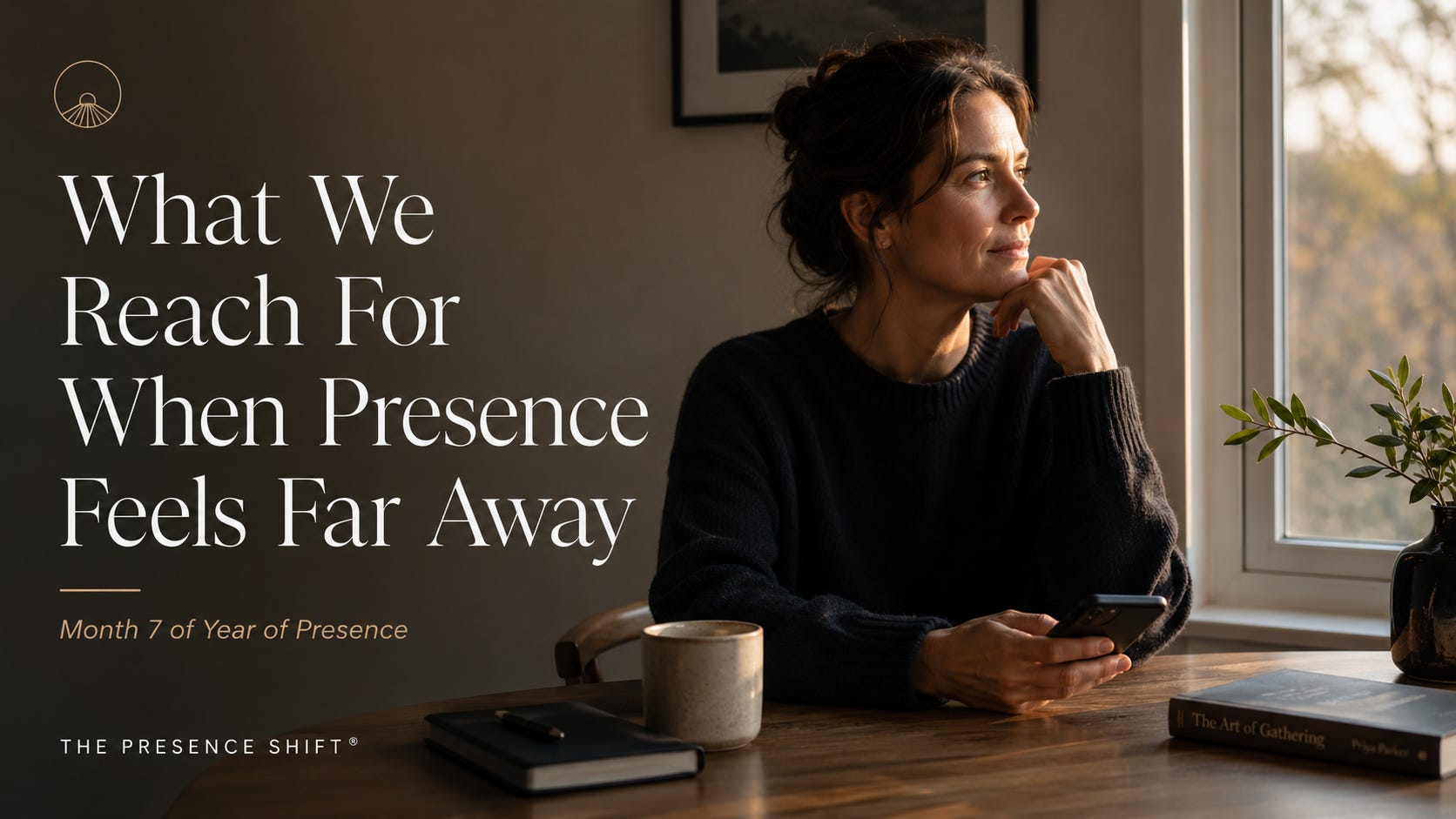
Hello friend,
Can you believe we’re into the seventh month of Year of Presence?
We’ll keep it rolling today by noticing what pulls us out of presence most.
If you are new here, you can begin now.
Year of Presence is not something you have to start perfectly on January 1.
It’s a year-round training path to grow more presence in your day-to-day life.
This month feels like the right time to look more closely at something simple:
What do you reach for when you lose touch with the miracle of life we’re each swimming through — and presence feels far away?
A screen?
A text?
A feed?
A drink?
A snack?
A search?
A purchase?
A person?
A fantasy?
An answer?
A private loop?
A new idea?
A new project?
A new tab?
What you reach for is not the enemy.
Often, the reach is trying to help you return to presence.
Sometimes it does help.
Learning something new can feel alive.
Making something online can be creative and meaningful.
A good conversation can bring us back to ourselves.
A song, a walk, a meal, a book, a message, a game, a workout, a show, or a search can shift our state.
There is psychology inside this.
The brain learns what changes our state.
It learns what gives relief, pleasure, novelty, stimulation, comfort, connection.
It knows what gives a feeling that something is there that is real to you.
Our reaching is not bad, but it usually has a historical reason behind it.
Sometimes we reach because we are curious, or lonely, or want to create.
And sometimes it’s because we want to disappear, feel more alive, or stop feeling what we’re feeling.
This is where the psychology of attachment comes in.
Attachment theory can predict where we’ll reach when we want safety, comfort, reassurance, or connection.
Is something there for me?
Can I be met?
Can I feel safe enough, or engaged enough, to return to my life?
Technology can answer part of that question very quickly.
The phone is there.
The feed is there.
The search box is there.
The notification might be there.
The AI answer is there.
The private loop is there.
The next thing is there somewhere.
And sometimes that helps.
But sometimes what is available is not the same as what is truly returning us to our next moment of presence.
Sometimes what we reach for gives relief without connection.
When it gives stimulation without nourishment, reassurance without rest, escape without return, or pleasure without presence, it can feel soothing while also feeling emotionally hollow.
This month is not about shaming the reach.
It’s about bringing presence to the moment before the reach.
Because one of the most important questions is not only:
What am I reaching for?
It is:
What am I reaching from?
Am I reaching from presence?
Or am I reaching from loneliness, urgency, shame, boredom, fear, restlessness, avoidance, or from the need to be reassured, to disappear, to feel something, or to not feel something?
The same action can mean different things from different inner states.
Opening your phone can be connection — or escape.
Learning something new can be growth — or avoidance.
Being creative online can be expression — or a way to outrun an uncomfortable feeling.
Sexuality can be alive, intimate, and embodied — or, for some people, digital pornography, or private sexual loops, can become a place they go to regulate pain, loneliness, shame, stress, or disconnection.
Food can be nourishment and pleasure, or it can become the only place the body feels comfort.
Work can be meaningful, or it can become the place we hide from needing anyone.
A Presence Shift is not here to make those choices for us.
It’s here to create one small moment of awareness before our next reach chooses for us.
That is our practice the next month.
Not perfection or purity.
Presence.
A moment to notice what is happening.
A moment to feel the body.
A moment to ask:
What am I hoping this will give me?
And what would help me fully return to my life?
The Presence Shift ritual is always the same:
Answer → Intend → Focus → Flow → Begin
For the next month, we’ll use it to study where we are reaching from.
A short practice
Step 1: Answer.
What’s the strongest feeling inside you right now?
Lonely.
Restless.
Tired.
Ashamed.
Curious.
Excited.
Numb.
Hungry.
One word is enough.
—
Step 2: Intend.
Silently say:
I return to presence before the next reach.
—
Step 3: Focus.
Feel your feet.
—
Feel your hands.
—
Feel your breath.
—
Feel the place in your body that wants something.
—
Let it be felt for a moment.
Before you give it the screen.
Before you give it the search.
Before you give it the loop.
Before you give it the next thing.
Ask quietly:
What am I hoping this will give me?
Comfort?
Energy?
Relief?
Connection?
Escape?
A feeling that I am okay?
Let your body know you are here.
—
Step 4: Flow.
See one next step.
Not your whole life.
Just one next step from presence.
—
Step 5: Begin.
Choose one small present action to lead you into your next hour .
Take a breath.
Stand up.
Put the phone down.
Keep creating, but with more presence.
Send one honest message.
Step outside.
Drink water.
Or reach for real support.
—
When you’re ready, begin.
Stay present,
Sean
—
This month
Over the coming weeks, we will look at the places we reach for when presence feels far away.
The phone.

The feed, the checking, the reassurance, screens, avoidance, learning, creating, private loops, compulsive patterns, etc.
And we’ll notice the deeper attachment question underneath many of them:
Is something there for me?
Can I be met?
Can I feel safe enough to return to my life feeling present?
The goal is not to become perfect.
The goal is to make your return to presence easier so you live with more daily presence.
A return practiced once is a moment.
A return practiced repeatedly becomes a capacity.
A capacity practiced over time becomes a way of living.
New here?
The simplest place to begin is the 60-Second Presence Profile.

You’ll receive a free psychologist-designed reflection in about 60 seconds.
It’s a short reflection on how you may tend to lose presence — and how you may begin returning.
This month, your Profile result can be one clue about how you tend to lose presence before you reach.
Do you lose presence through urgency, through withdrawal, through pressure, through emotion, through numbness, through the need to know?
Your Profile will help you notice your starting pattern.
After you read your Profile, begin Presence Shift Foundation to officially begin your Year of Presence.
—
Sean Sullivan, PsyD, is a licensed clinical psychologist and creator of The Presence Shift®, a science-based, five-step ritual for returning to presence in real-life moments. His year-long training, Year of Presence, helps people live with more presence through five Inner Steps that become second nature.
Important note
This work is designed as presence and nervous-system training.
It is not a substitute for medical or mental health care.
This is not therapy, diagnosis, medical advice, addiction treatment, or crisis support.
It is a short presence-training practice.
This month may include references to technology use, compulsive patterns, substances, pornography, sexuality, relationships, and other emotionally sensitive topics.
If a substance, behavior, relationship, or technology pattern is causing significant distress, impairment, danger, withdrawal, relapse risk, or loss of control, consider trusted professional support.
If you are in immediate danger, contact local emergency services.
If you need crisis support in the U.S., call or text 988.
Emotional Safety Notice & Warning
The statements on The Presence Shift® have not been reviewed by the Food and Drug Administration.
This project is not intended to diagnose, treat, cure, or prevent any disease.
The Presence Shift® is not intended as medical advice or as a replacement for professional health or mental health services.
Some content may be emotionally provocative, including references to anger, conflict, abuse, trauma, grief, boundaries, addiction, compulsive behavior, pornography, sexuality, and other difficult experiences.
If you are not feeling comfortable, please stop until you feel safe again.
You can explore getting emotional support anytime at wannatalkaboutit.com — or by calling 988 in the United States or your local crisis line.